
A brave horizon
A destination brand
for Gijón/Xixón
A brave horizon
A destination brand for Gijón/Xixón


A particularly sensitive context
The project was born at a decisive moment for the city. Gijón/Xixón needed to update its tourism positioning and build a unifying narrative aligned with a long-term vision.
The objective was to define a platform capable of guiding the destination’s narrative, design, communication and future activation.
The context was particularly sensitive. Like many northern cities, Gijón/Xixón has to compete in an increasingly saturated landscape of similar discourses: authenticity, sustainability, gastronomy, heritage, quality of life. Many cities want to be open, liveable, cultural and responsible. The risk was falling into a narrative that was correct, but indistinct.
From that starting point, we worked on a new tourism brand strategy for Gijón/Xixón: a brand capable of organising its story, strengthening its communicative self-confidence and projecting an idea of destination that was coherent with its truth. The aim was not to beautify the city from the outside, but to listen to what was already beating within it and give it a strategic, verbal and visual form capable of accompanying its future. The 2025–2035 Strategic Plan had already set a clear direction: to build an authentic, sustainable and competitive destination, where tourism contributes to citizens’ wellbeing and reinforces local identity as a driver of development.

The origin: a brand born from everyday life
Some cities can be explained through what can be seen. Others can only be understood when they are lived. Gijón/Xixón belongs to this second kind.
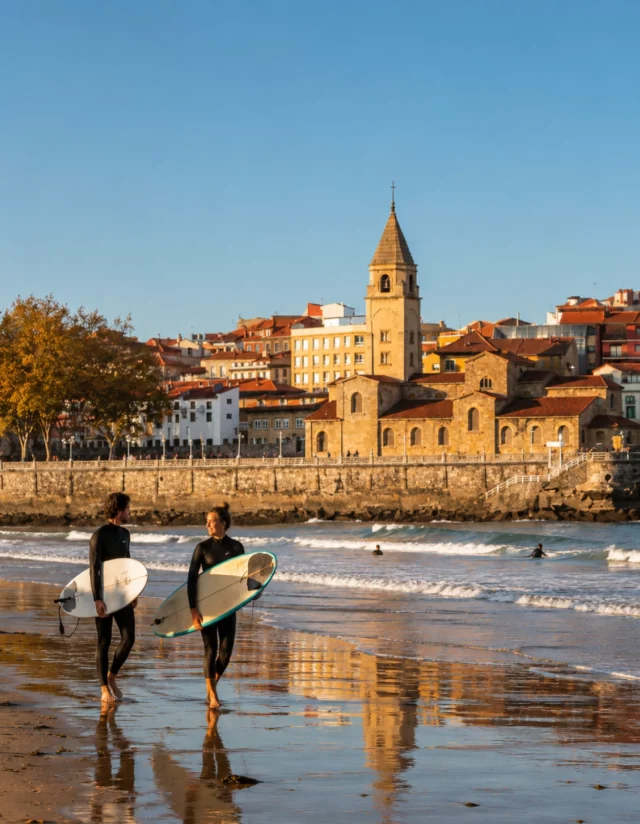
An intense round of personal interviews with different representatives of Gijón society, together with a street-level citizen survey carried out with a broad sample, revealed that Gijón is not a city built for the postcard. Its strength lies elsewhere: in the life that happens on the street, in conversations that stretch on in the chigres, in the sea as a daily presence, in the mix of neighbourhoods, culture, work, commerce, cider, wind, industry, entrepreneurship and horizon.
It also lies in the meadows of the more rural concejos, in paths surrounded by green, in the smell of wet grass when the orbayu falls, and in a particularly active creative scene, capable of connecting memory, popular culture and a contemporary outlook. A city with character, pride, natural hospitality and a way of life that does not need to invent or falsify anything in order to be attractive.
An open, vital and approachable city; a city with a working-class and solidary heritage, but also with an entrepreneurial bourgeoisie; a city that finds its authenticity in everyday gestures: cider, merenderos, swimming in the sea, neighbourhoods, popular festivities, social mixing and conversation.
A polyhedral city, difficult to reduce to a single icon, because its identity does not lie only in a monument or a recognisable landmark, but in a way of being in the world.
The challenge was precisely there: to transform a deeply felt identity into a brand capable of being understood, shared and activated.


The diagnosis
The city came to the project with an identity that was highly recognisable to those who live there, but not always sufficiently articulated outwardly.
The initial diagnosis showed a poorly defined tourism identity, fragmented communication and a certain dependence on the Asturias umbrella. Another idea also emerged strongly, one that would become central: the desire to project itself with greater confidence, to “believe in itself a little more”, without losing simplicity or truth.
Applying our Hospitality Brand Balance framework, the main challenge was to build a tourism brand without turning the city into a tourism product.
- From the perspective of economy, the brand had to strengthen Gijón/Xixón’s competitiveness, help attract quality visitors — not volume, but those who truly come to recognise, respect and enjoy that way of life. It also had to help reduce seasonality and organise audiences, but without pushing the city towards a rootless growth model. Tourism had to contribute to local life, not replace or damage it.
- From the perspective of emotion, the project called for a narrative capable of touching something true. Gijón/Xixón is not remembered only for its places, monuments or tourism offer, but for what it awakens in those who experience it: closeness, intensity, freedom, belonging. That is why the story could not be limited to beaches, culture or gastronomy, but had to speak of a collective energy that is contagious.
- From the perspective of the environment, the brand had to recognise that the city is not a backdrop, but a living system. Neighbourhoods, associations, commerce, culture, the port, the sea, the landscape, working-class memory, hospitality and citizenship are all part of the same reality. The strategy had to look at the destination from within, respect its rhythm and avoid turning local life into spectacle.
- And from the perspective of balance, the decision was to hold the tension between tourism and citizenship, between projection and truth, between synthesis and complexity. Two risks had to be avoided: remaining within a descriptive, institutional and cautious narrative, unable to express the true pulse of Gijón/Xixón; or falling into a folklorised version of the city, reducing its identity to recognisable but insufficient clichés.

Our reading was clear: Gijón/Xixón should not compete through obvious beauty, monumentality or conventional aspiration.
Its difference did not lie in appearing more sophisticated, more orderly or more tourist-oriented, but in being more itself. In showing itself as real and imperfect in a time of overproduction and idealisation, with all its layers: sea and industry, neighbourhood and culture, tradition and modernity, working-class pride and entrepreneurial bourgeoisie, contemporary creativity with a vision for the future and popular energy. Its identity was not clean in a decorative sense. It was alive, complex, used, inhabited. And that complexity should not be simplified until it became generic.
The benchmark confirmed that many destination brands moved within predictable codes, with correct but poorly differentiated narratives. Against that, Gijón/Xixón could occupy a braver territory: that of a city that does not seek to resemble others, that does not settle into the postcard, and that understands modernity as a form of coherence. Almost a form of contemporary counterculture: being real when almost everything tends to look produced.
The strategic conclusion was that the brand had to express movement, truth and humanity. Not an aesthetic or technocratic modernity, but a vital modernity: a way of moving forward while remaining faithful to its own roots.
Brand territory and positioning
The chosen territory was Vital modernity. A way of understanding Gijón/Xixón as the new modernity of the north: real and rooted. A city where being truthful becomes a contemporary gesture. Where moving forward does not mean becoming something else, but transforming from within what one already is.
The platform defines this modernity not through appearance, icons or trends, but through coherence, integrity and the ability to remain alive without losing truth.
This territory allowed the brand to move from a more institutional and landscape-based narrative towards a more emotional, vibrant, open and characterful one. It was not about saying that Gijón/Xixón is modern because it changes, but because it dares to change without blurring itself.
The brand idea condensed that vision: Gijón is a living city, a collective energy that transforms without losing its truth.
And the tagline, Gijón/Xixón, horizonte valiente, brought that idea into a more open and memorable expression. Horizon as sea, future, breadth and gaze. Brave as coherence: the courage of a city that dares to be who it is.


The visual universe: the map as a living system
The visual identity begins with a significant decision: not to reduce Gijón/Xixón to an obvious tourism icon.In a city with such a complex identity, choosing a literal symbol would have been more comfortable, but also more limiting.
The sea, the letters, the beach, cider, Cimavilla or the horizon could have worked as recognisable resources, but they risked enclosing the city once again within a partial image. The strategy asked for something else: an identity capable of speaking of neighbourhoods, movement, openness, mixture and future.


That is why the city plan became the starting point. Not as a map that delimits, but as a form that opens, evoking a city that moves forward, that pushes ahead, that does not close in on itself.
The map’s layout adopts an irregular geometric foundation that dialogues with the visual memory of Gijón/Xixón: the modernist typefaces of the early 20th century, the urban architecture, the structures of the port and that industrial reading that forms part of the city’s deeper matter.
Diagonals, cuts and colour planes introduce movement and expansion. It is a system that looks ahead, just like Gijón, and that does not illustrate the city from the outside; it interprets it from its internal structure. The map ceases to be a contour and becomes a language.


The identity of Gijón/Xixón does not seek to resolve the city into a single image; it seeks to create a system capable of holding its layers.


We were looking for a form of appropriation that did not arise from literalness, but from the feeling that the brand does not simplify, caricature or turn what is local into a souvenir. The sign gains meaning in relation to the system: through colour, typography, collage, movement and the way the identity unfolds across applications. That is where its intention lies: less tourist-oriented in the conventional sense, more contemporary in the strategic sense.
The logo also resolves, for the first time, a particularly sensitive issue in the visual history of the brand: the coexistence of Spanish and Asturian at the same graphic level.
Gijón/Xixón no longer appears as a subordinated sum or as a difficult-to-order duplication, but as a balanced, clear and recognisable bilingual unit. This is not only a formal solution; it is a symbolic decision. The brand assumes the dual denomination as a natural part of its identity, without visual hierarchies, integrating language, territory and belonging in a single brand gesture.
The black-and-white photographic collage brings memory, texture and truth. It introduces real fragments of the city, cuts them, overlays them and makes them coexist with geometric planes of colour. There appears a Gijón/Xixón made of layers: sea, industry, neighbourhood, culture, green and wind. Not a clean and decorative city, but a city with matter.
The Strawford typeface, from the Gijón-based foundry Atipo, adds another important gesture: an identity with contemporary ambition, but anchored in local talent. Geometric, clear and versatile, it brings structure without erasing character. Red works as energy, DNA and emotional presence; white opens up space, breath and horizon. The result seeks a vibrant, brave and clean identity, flexible enough to move between institutional communication, tourism campaigns, urban supports and city narratives.

A singular identity that does not seek to connect only through immediate familiarity, but to build a new familiarity through use, coherence and time.


The new voice: a verbal identity with truth and pulse
The verbal identity had to move away from both institutional language and generic tourism language. Gijón/Xixón could not speak like a city trying to sell itself from the outside. It had to speak like a city that knows what it is.
The voice we built is direct, human, vital and honest. It has a close energy, but is not complacent. It can be emotional without becoming contrived. It can be proud without sounding arrogant. It can speak of the future without abandoning memory.
Its tone is born from a very Gijón/Xixón mix: naturalness, character, humour, openness, popular culture, social awareness and a point of nonconformity.
The manifesto captures that way of speaking through an almost physical sequence: you do not come to look, you come to feel; the city passes through you; the sea speaks; its vitality clings to your skin. Then come language, pride, culture, salt air, working-class memory, El Natahoyo, El Llano, El Musel, San Lorenzo, Cimavilla, Deva, Granda, Cenero. Not as a tourism inventory, but as layers of a real city.
The brand avoids exaggeration, empty claims and the postcard. It emphasises lived experience, mixture, community, everyday truth and the capacity for transformation. It speaks to the visitor, but it does not stop speaking to the city. That was one of the essential points: for the new brand to work as a tool for promotion without ceasing to be a form of recognition.


Impact and learning
The project has made it possible to move from a dispersed identity to a clear brand platform, capable of articulating purpose, territory, idea, values, personality, tagline, manifesto and visual system.
The brand ceases to be merely a tourism communication tool and becomes a way of facilitating decisions about how to grow, how to attract, how to communicate and how to protect the truth of the destination.
- In terms of economy, the brand helps the city compete from a place of its own, less dependent on attributes shared by other northern destinations and more focused on an advantage that is difficult to copy: the city’s real energy.
- In terms of emotion, it builds a promise deeper than the visit: Gijón/Xixón is not looked at, it is lived.
- In terms of environment, it recognises that the destination cannot be sustained without its community, its neighbourhoods, its memory, its ambition for the future and its everyday life.
- And in terms of balance, it proposes a way of moving forward without turning the city into a simplified version of itself.
This project confirms something we deeply believe: a destination brand should not invent a place, but help it recognise itself more clearly. Strategy is not there to disguise reality, but to reveal what already has strength and turn it into a system. In Gijón/Xixón, that strength lay in a very concrete truth: a living, collective, open city, with working-class memory and entrepreneurial pulse, creative and joyfully alive, that does not need to resemble anyone else in order to look ahead.
A living city that transforms, always looking forward, always ready to move ahead, and that leaves a trace of sea and truth.